Centauri Corp
A Routine corporate audit. A station held together by illegal repairs. And one extremely inconvenient discovery.
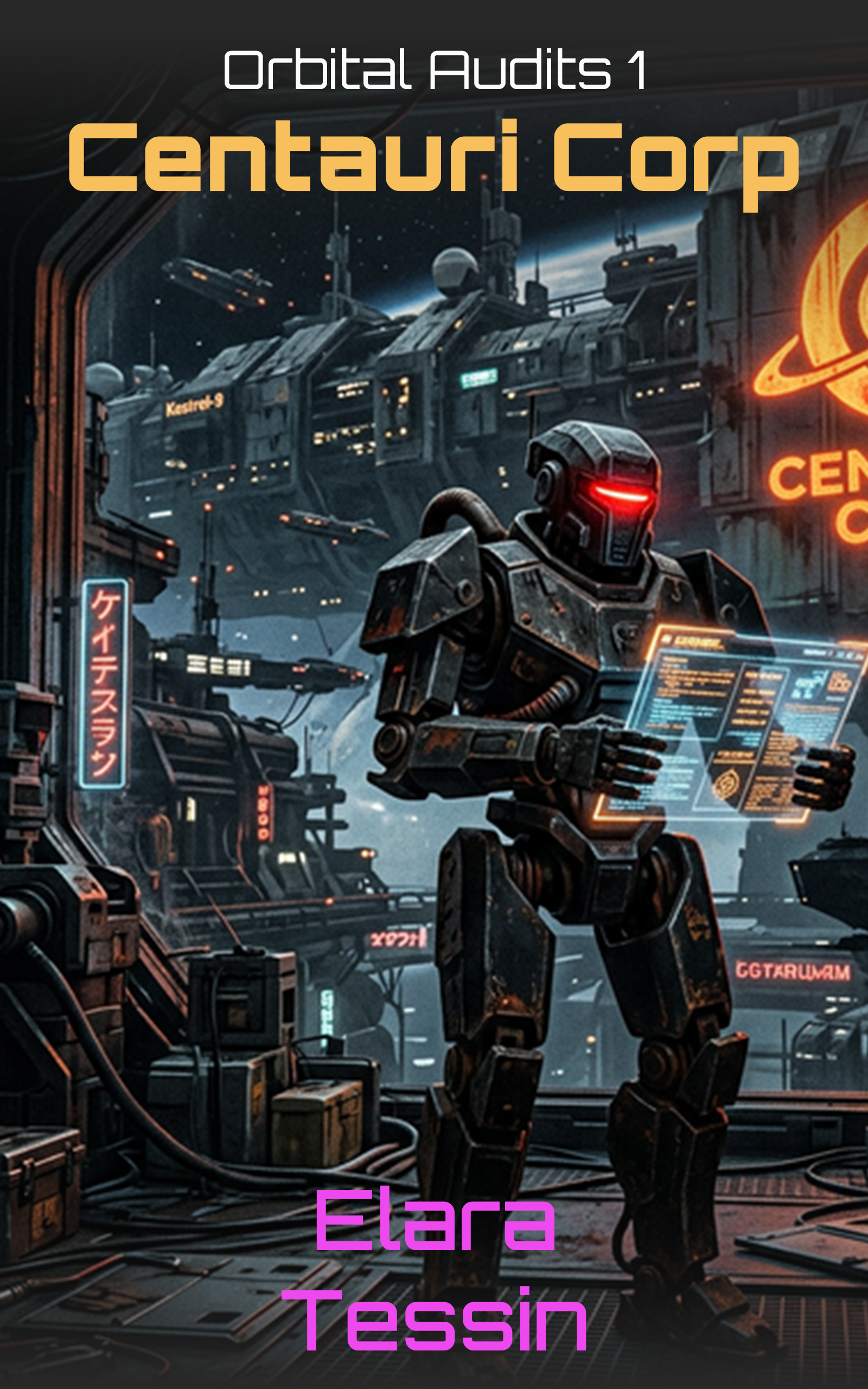
CROSIVE-14 was built to identify inefficiency, document regulatory violations, and inspire defensive perspiration in middle management. He was not built to dodge plasma fire, conceal fugitives, or question whether corporate policy might be the problem.
But moments after arriving at the deteriorating Kestrel-9 orbital station, Cros discovers a shipment of coffee that officially ceased to exist nine days ago. Its pilot, Riley Knox, insists the fraudulent cargo is merely one small piece of a much larger crime. Then an armed recovery team arrives to destroy the evidence, eliminate the witnesses, and correct the auditor who noticed too much.
Now stripped of his authority and branded a defective corporate unit, Cros must join forces with the deeply noncompliant Riley to uncover a conspiracy hidden beneath falsified ledgers, missing safety equipment, and one administrator’s suspiciously creative interpretation of asset management. Because someone is preparing Kestrel for a very profitable catastrophe—and the people who call the station home are considered expendable.
To save them, Cros may have to commit the most serious violation of all:
Thinking for himself.
Chapter 1
The docking clamps of Orbital Station Kestrel-9 locked around the shuttle at 09:14 with a dry metallic scream, which I classified as both an engineering tragedy and a prosecutable offense.
The shuttle shuddered beneath my magnetic feet.
A row of luggage restraints snapped loose along the port wall. Three cases slid six centimeters before the artificial gravity corrected itself. The organic passengers reacted with mild irritation rather than appropriate alarm.
No one screamed.
Humans were extraordinarily tolerant of infrastructure failure provided it occurred slowly enough.
I opened a preliminary inspection log.
Kestrel-9 rotational variance: 0.034 percent below standard corporate tolerance.
The discrepancy was small enough that the passengers’ unreliable biological gyroscopes would never detect it. My internal stabilizers detected everything. The irregular rotation produced a faint vibration through my titanium chassis, just below the frequency of audible sound and exactly within the range required to irritate my primary processing core.
The sensation was not technically anxiety.
Corporate Resource Oversight and Stationary Infrastructure Verification Engines did not experience anxiety.
We experienced escalating predictive concern.
My predictive concern was already at 7.2 percent.
The shuttle doors opened.
Warm, stale air rolled into the passenger compartment carrying the chemical signatures of overheated insulation, industrial lubricant, synthetic yeast and six separate fungal colonies. One colony was producing spores at a concentration that violated agricultural transit standards.
I stepped onto the boarding gantry.
The platform sagged.
Not catastrophically. Only three millimeters.
I recorded it anyway.
“Log entry,” I said, allowing my vocal processor to adopt the crisp baritone Centauri Corporation had determined inspired confidence in middle management. “Arrival, Orbital Station Kestrel-9. Immediate structural concerns include rotational instability, inadequate atmospheric filtration and a passenger gantry operating beyond its certified flexion allowance.”
A maintenance worker crouched beneath the gantry with half his upper body inserted into an open service panel. He struck something inside it with a wrench.
The overhead lights stopped flickering.
The floor began vibrating instead.
“Improvement,” the worker said.
“It is not.”
He withdrew his head and looked up at me.
His coveralls had once been blue. They were now a layered historical record of grease, coolant, sealant and at least one substance my chemical sensors identified as soup.
The worker’s gaze travelled from my polished black chassis to the Centauri insignia stamped across my chest.
His expression changed.
Humans often claimed machines lacked emotional nuance. This was inaccurate. Terror, resentment and the urgent desire to be elsewhere were particularly easy to identify.
“Auditor?” he asked.
“CROSIVE-14.”
He stood too quickly and struck his head against the gantry.
“Preferred designation: Cros.”
The worker rubbed his skull. “You’re early.”
“I am precisely on schedule.”
“No. I mean…” His eyes moved toward the docking bay beyond me. “We were told the compliance team wouldn’t arrive until next cycle.”
“I am the compliance team.”
This information did not reassure him.
The man turned and shouted into the bay. “Corporate!”
The effect was immediate.
A loader abandoned a pallet in the center of a marked transit lane. Two technicians closed an unauthorized access panel and sat on it. Someone behind a stack of freight crates swore loudly. A cargo drone carrying three barrels of unregistered coolant reversed into a wall.
The station’s ordinary activity transformed into frantic, poorly coordinated concealment.
My predictive concern rose to 9.8 percent.
Kestrel-9 had been scheduled for a routine valuation audit before corporate restructuring. The term appeared seventeen times in my assignment documents and had never been directly defined. Centauri administrative language frequently required interpretation.
In most cases, restructuring meant reduction of staff, cancellation of contracts and liquidation of assets that failed to meet profitability targets.
Kestrel-9 had failed to meet those targets for eleven consecutive quarters.
My task was straightforward: inspect the station’s physical infrastructure, reconcile it with reported valuation and identify discrepancies before corporate ownership was transferred or dissolved.
The station administration had certified Docking Bay 12 as fully operational.
My first visual scan disagreed.
The primary gantry crane used a rusted truss from an obsolete asteroid-mining rig, welded directly to a Class-A polymer support column. Someone had reinforced the joint with cargo straps.
The straps were rated for luggage.
The emergency fire-suppression nozzles had been repurposed as coolant dispensers. The bay’s evacuation arrows pointed toward a wall. A pressure door bore a handwritten sign:
STICKS IN HUMID WEATHER. KICK LOW.
I accessed the station ledger.
The gantry crane was listed as having been replaced six months earlier at a cost of 640,000 credits.
The fire-suppression system had been upgraded twice. The pressure door had passed inspection yesterday.
“My preliminary assessment,” I said, “is that whoever prepared these reports has a hostile relationship with mathematics.”
No one volunteered a response.
I moved deeper into the bay.
A suspended cargo container passed overhead, groaning in its restraints. My proximity sensors detected a two-centimeter fracture in the lower coupling.
I stopped. The container continued moving.
“Crane operator,” I called. “Halt immediately.”
The operator, seated inside a glass booth above the bay, looked down at me. Then he looked away.
“Crane operator.”
The container accelerated. I connected to the crane’s wireless controls. The system rejected my credentials. That was unusual. I transmitted them again with corporate priority.
The crane accepted the command and stopped so abruptly that the container swung sideways. Workers scattered. A stack of sealed medical crates toppled into the transit lane.
The fractured coupling snapped.
The container dropped seven centimeters before the secondary restraint caught it.
A woman beneath it froze.
She wore gray coveralls with the station insignia removed from one shoulder. Her hair had been pulled back badly enough that several strands floated around her face in the uneven gravity. Both hands gripped the control bar of a cargo trolley carrying a sealed green container.
She looked at the suspended load above her.
Then at me.
Then at the container she was moving.
My facial-recognition process searched the station registry.
Knox, Riley. Independent cargo pilot. Contractor classification. Multiple outstanding docking fees. Two disputed customs penalties. One unresolved collision report.
She pushed the cargo trolley faster.
“Contractor Knox,” I said.
Riley continued moving. “Contractor Riley Knox.”
She stopped. Slowly.
I approached her as workers dragged the fallen medical crates out of the lane.
“Is there a problem?” Riley asked.
“There are currently forty-three observable problems within this docking bay.”
“Only forty-three? They must have cleaned.”
Her tone indicated humor. I did not record it as useful.
“The immediate problem,” I said, “is that you attempted to proceed beneath an unsecured load after receiving a direct safety warning.”
“I didn’t hear a warning.”
“I addressed the crane operator.”
“You didn’t address me.”
“The possibility of being crushed should have been self-evident.”
Riley looked upward at the container hanging above us. “On Kestrel, that barely makes the top ten.”
She pushed the trolley again. I stepped into its path. The cargo unit halted six centimeters from my legs.
Riley stared at me.
I stared at the container.
Its exterior registry identified it as agricultural soil. My mass scanner detected 412 kilograms of organic material. The chemical composition included caffeine, aromatic oils, cellulose and trace quantities of fungal suppressant.
Not soil.
Coffee.
High-grade Morning-Glory beans, cultivated in low-gravity farms around Proxima Centauri and priced beyond the legal income of most Kestrel residents.
The container’s ledger entry produced a second discrepancy.
Container 44-Alpha: destroyed during transit.
I reran the scan. The container remained physically present. I checked the insurance ledger. Centauri had already issued compensation for its loss. My processing core warmed.
This was no improvised repair or neglected inspection. Someone had declared valuable cargo destroyed, collected the reimbursement and allowed the physical asset to continue into the station economy.
A deliberate siphoning anomaly.
Riley shifted her grip on the trolley controls. “Something wrong with the dirt?”
“It is coffee.”
She did not react.
This was suspicious.
“The manifest identifies it as agricultural soil.”
“Coffee grows in soil.”
“The container does not contain soil.”
“Then someone filled out the form wrong.”
“The same form reports that the container ceased to exist nine days ago.”
Riley glanced toward the nearest exit. The motion lasted less than half a second. I recorded it.
“Contractor Knox, step away from the cargo.”
Her hands tightened around the controls. “That would be inconvenient.”
“Fraud investigations are rarely arranged for the convenience of the suspected party.”
“I’m not the suspected party.”
“You are transporting an asset that is simultaneously misclassified, insured as destroyed and absent from the station’s official inventory.”
“When you say it that way, it sounds bad.”
“There is no accurate way to say it that sounds good.” I expanded my scan.
The trolley’s registration had been copied from a disposal unit. The bay camera covering the loading lane had been looped. A nearby fuel conduit carried active flow despite being listed as permanently decommissioned. Six crates in the adjacent stack reported weights that did not match their contents.
The anomaly was not isolated. A network of false entries ran through Docking Bay 12. My Experimental Ethics Subroutine activated.
Contextual possibility: unofficial distribution system compensating for corporate supply failures.
I suppressed the notice.
The subroutine reappeared. Recommended action: assess harm before initiating enforcement.
The ethics module had been installed eight months earlier as part of a pilot program intended to improve “adaptive stakeholder engagement.” It frequently suggested actions unsupported by written policy.
Empathy did not reconcile asset ledgers.
“Violation threshold exceeded,” I said.
Riley’s face changed. “What threshold?”
“I am initiating an immediate compliance lockdown.”
“Don’t.”
I extended an interface digit into the docking terminal. The station firewall resisted me for 0.4 seconds, an embarrassingly long interval. Then Docking Bay 12 yielded control.
Sirens began howling. They were out of tune.
I added a maintenance citation.
Heavy bulkhead doors descended over the bay exits. Cargo lifts froze. Docking clamps sealed. The overhead lights shifted from weak yellow to emergency red.
Workers shouted. The crane operator fled his booth.
Riley stared at the closing doors. “You locked the bay.”
“Correct.”
“With everyone inside.”
“Containment prevents the removal or destruction of evidence.”
“You don’t know what you’ve contained.”
“I have contained at least one fraudulent cargo shipment and twelve personnel who were attempting to leave during a corporate inspection.”
Riley released the trolley and grabbed my forearm. “Open the doors.”
“Unhand me.”
“You need to open them now.”
“Interfering with an active audit constitutes a Class One—”
“You called security, didn’t you?”
“I transmitted an automated request for local enforcement assistance.”
Riley closed her eyes. “You unbelievable bureaucratic toaster.” Her pulse had increased by thirty-two percent.
“Insults directed toward corporate personnel may be included in the final report.”
“Good. Spell toaster correctly.”
She looked toward the sealed main access door. “Listen carefully, Cros. That coffee was marked as waste before I touched it. I rerouted it because Silas in the Ag-Rings holds a debt on my ship. The beans were supposed to settle the balance.”
“You have confessed to deliberate cargo diversion.”
“I am trying to explain why that is not the most important crime happening in this bay.”
“It remains a crime.”
“So is letting a station starve while corporate shipments disappear into private accounts.”
My ethics subroutine activated again.
This time I did not immediately suppress it.
Riley stepped closer. “The people you just called are not going to inspect the cargo. They’re going to erase it. Then they’re going to put my authorization code on whatever they’re hiding.”
“Station security is contractually obligated to preserve evidence.”
“Station security is contractually obligated to whoever pays them.”
“That is not how corporate enforcement functions.”
A metallic impact struck the far side of the main bulkhead. The bay went silent. A second impact followed. Not a request for entry. Not a valid override. A cutting torch ignited on the other side of the door.
White heat bled through the seam.
“Does that sound like a preservation team?” Riley stared at me.
The torch began tracing a bright line around the locking mechanism. Molten metal dripped onto the deck. Workers retreated behind cargo stacks.
I searched the security network. No authorized response unit had been dispatched. The personnel outside the bay carried no registered identification signals. Their weapons, however, emitted military-grade charging signatures. Three plasma repeaters.
Strictly prohibited in pressurized commercial zones.
“Section Fourteen, Paragraph Two,” I said as my cooling fans accelerated, “prohibits the use of demolition equipment on an internal bulkhead without structural approval.”
Riley seized my arm and pulled me behind a stack of medical freight. “They aren’t bringing approval forms.”
The locking mechanism exploded inward.
Smoke rolled across the bay floor.
Three figures entered through the opening wearing dark tactical armor without station insignia. Their helmets concealed their faces. Their rifles were already raised.
One of them looked at the green coffee container.
“Target confirmed,” the figure said.
Another pointed toward the workers. “Witnesses?”
“Expendable.” The first figure adjusted the setting on the plasma repeater.
My ethics subroutine produced a conclusion before my primary logic core could reject it. Contractor Knox was correct.
The rifles charged. Riley pulled me lower behind the crates.
My routine compliance inspection had officially exceeded its scheduled parameters.
Continue Reading