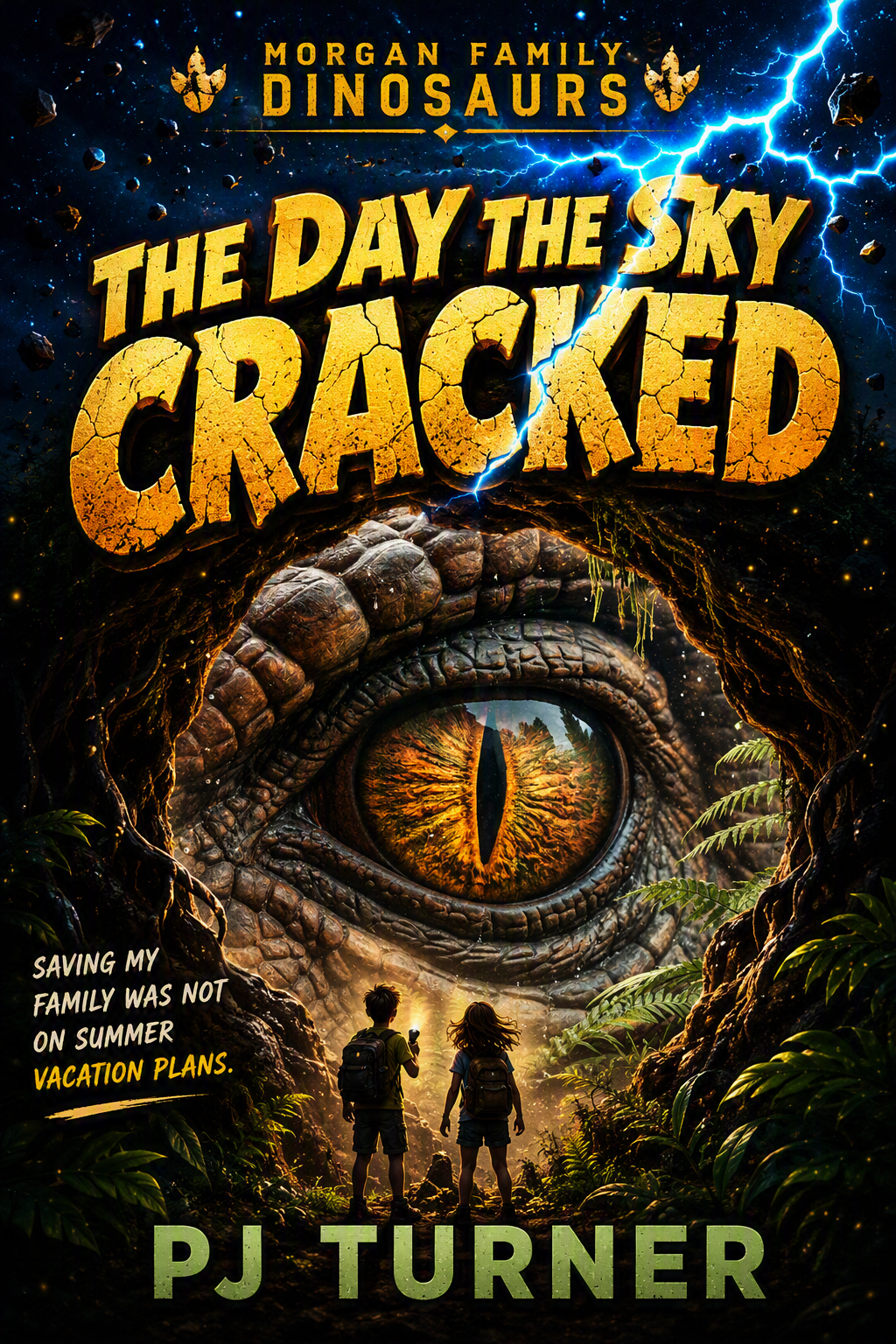
The Day the Sky Cracked
Piper Morgan’s summer is already ruined.
Instead of friends, freedom, and absolutely no homework, she is stuck on a family research trip with her brilliant mom, overprepared dad, furious older sister, and dinosaur-obsessed little brother. Then the sky cracks open.
One flash of light later, the Morgans wake up in a world with no roads, no phones, no rescue…
and dinosaurs everywhere.
At first, everyone expects Piper’s parents to know what to do. Mom studies ancient ecosystems. Dad can fix almost anything. Sadie is brave enough to run straight into danger. Theo knows more dinosaur facts than any normal human should.
Piper is just the middle kid. The quiet one. The one everyone thinks is fine.
But Piper notices things the others miss.
The forest goes silent before something huge moves through the trees. A strange red thread appears where no thread should be. Broken pieces of modern metal turn up millions of years before anyone could have made them.
And when a terrifying predator traps her family near a patch of jungle that looks sick and wrong, Piper realizes the dinosaur may not be hunting them.
It may be running from something worse.
To survive, the Morgans will have to stop arguing and start working together. But the Cretaceous is hiding more than teeth, claws, and giant footprints.
Because buried in the mud is a metal tag stamped with one impossible word:
MORGAN.
Someone knew they were coming.
Chapter 1
“Excellent material for your summer essay,” Mom said, which was one of the worst sentences a parent could say in June.
Piper stood beside the open back of the SUV and looked out at the research-site staging area with the flat, betrayed feeling of someone who had been promised summer and was given clipboards instead.
This was supposed to be the summer she stopped being the one everyone packed around. Instead, Mom had apparently planned her schoolwork, her activities, and possibly every thought she was expected to have before they had even finished unloading the car.
The place was a scraped clearing at the end of a gravel road so narrow the side mirrors had picked up scratches from brush on the way in. Beyond it, low trees crowded close, their leaves silver-green in the heat. The air smelled like dust, sun-baked plants, and the sharp mineral tang of equipment cases that had been riding too long in the back. A tarp was half-strung between the vehicle and a pair of poles. Plastic bins, hard cases, coiled cords, sample coolers, folding tables, and three water jugs sat in various stages of being unloaded.
In other words, paradise, assuming paradise came with clipboards, extension cords, and mandatory educational enrichment.
Mom was already moving between cases with the cheerful speed she always had at the start of fieldwork, like the trip had finally become real now that there was labeling tape involved. She wore her hat, her faded field shirt, and the expression that meant half her brain was with the family and the other half was already arranging data into neat columns.
“Seriously?” Sadie said from the other side of the bumper. “You brought her stuff for school?”
“It’s not for school,” Mom said.
Piper took one look at her mother’s face and knew that meant it was at least seventy-percent schoolwork.
Mom reached into a supply crate and handed over a black book tucked inside a clear waterproof pouch with a yellow zip seal. There was also a loop at the top for clipping onto a pack. Piper pulled it out to see what the fuss was about. It had a sturdy cover that bent without creasing. Somebody had thought about mud, rain, and dropped things.
“It’s a journal, for observations,” Mom said, pointing. “Sketches, notes, questions, anything you want to keep track of. You’ll have excellent material by the end of the week.”
There it was again. Excellent material.
Piper took the journal because not taking it would turn this into a conversation, and conversations about summer assignments never improved with time.
“Wow,” she said. “My very own wilderness essay prison.”
Mom looked pleased, like she had solved Piper.
That made it worse.
Theo, who had been kneeling on the gravel trying to free a bungee cord from a cooler handle, popped upright. “Do dinosaur facts count as observations?”
Sadie made a sound that was almost a laugh. “Prehistoric homework. That’s so bleak.”
Mom ignored the bleak part. “If Piper wants to include factual details, yes, factual details count.”
Theo brightened immediately, as if this were a collaboration request addressed specifically to him. “Because if there’s anything about extinction events, I can help.”
“Shocking,” Sadie said.
Piper slid the journal back into the pouch. “Fine. You can be my unpaid dinosaur consultant.”
Theo’s face lit up. “That is an official scientific position.”
“It is absolutely not,” Sadie said.
“It is if I observe it,” Theo said.
Piper slid the journal back into the pouch. She pressed the yellow seal shut again, testing it without meaning to. It snapped cleanly into place.
Mom noticed that and smiled like she’d scored a point. “It’s waterproof.”
“That’s great,” Piper said.
What she did not say was that Theo got to be useful on purpose, Sadie got to be trusted with things that could actually keep people alive, and Piper got paper.
Dad came around the back of the SUV carrying a red zippered pouch and a small black hard case under one arm. He moved the way he always did when they traveled anywhere more challenging than a hotel: quick, tidy, and already three steps ahead of everyone else. He set the hard case on the tailgate, checked the latch twice, then held out the red pouch toward Sadie.
“Your kit,” he said.
Sadie pushed off the bumper and took it. Her expression said she would have preferred not to be assigned anything by anybody, but her hands closed around the pouch immediately. “I know it’s my kit.”
“I know you know.” Dad nodded. “Keep it with you.”
“I was planning to juggle it for fun, actually.”
Dad let that pass. “Side pocket has the filter. Don’t bury it under everything else.”
Piper saw the change happen in Sadie’s face before it disappeared again. Annoyance first. Then the quick, private satisfaction of being the one Dad trusted with something important.
Sadie unzipped the kit all the way and spread it open on the tailgate. Flashlight. Whistle. Emergency blanket. Small first-aid pack. Filter pouch. Orange-cased lighter. Roll of cord. Folded foil packet Piper did not recognize.
Sadie touched each item once, fast and businesslike, as if she was only checking because Dad would ask.
Then she took everything out.
Dad’s eyebrows lifted.
“What?” Sadie said. “If I have to carry the apocalypse purse, I’m not carrying it wrong.”
Theo leaned closer. “Is apocalypse purse the official term?”
“No,” Dad said.
“Yes,” Sadie said.
She repacked the kit in a different order, heavier things at the bottom, whistle clipped where she could reach it, filter pouch in the side pocket like Dad had said without letting him enjoy that she had listened. The lighter went in last. She zipped the pouch and slung it across her shoulder like she’d been doing it forever.
Dad looked like he wanted to say something.
Sadie pointed at him. “Do not make this a moment.”
He closed his mouth.
Piper looked down at the journal in her hands.
Sadie got fire, water, cord, and a whistle.
Piper got paper.
“Congratulations,” she said to Piper. “You got homework. I got potential dehydration.”
“You say that like you’re jealous.”
“Of your notebook?” Sadie tilted her head. “Deeply.”.
“I can carry something real,” Piper said.
Dad glanced toward the journal pouch. “You are carrying something.”
“A notebook doesn’t count.”
Mom’s hand paused over the supply crate. “It does if you use it.”
Which was exactly the kind of answer adults gave when they had no intention of trusting you with anything breakable, sharp, expensive, or important.
Theo climbed to his feet, brushing gravel off his knees. “A journal is useful. People on expeditions keep journals all the time.”
“Please never say ‘people on expeditions’ about this family again,” Sadie said.
Dad was already checking the rest of the gear. Water jugs. Medical case. Tool bag. Satellite unit. Battery packs. He touched each thing once and counted under his breath too quietly for Piper to catch all the numbers. She heard the clipped rhythm of it anyway.
Mom pointed toward a folded camp chair. “Piper, you can put the journal in your pack.”
Piper clipped the pouch to the inside of her backpack instead of dropping it loose among snacks and sunscreen. She told herself she was only doing that because if the thing got bent on the first day, she would never hear the end of it. The little metal clip clicked against the zipper ring. Secure.
Theo had gone very still in that particular way that meant he was about to produce evidence.
“Oh,” he said.
Sadie narrowed her eyes. “Why do you sound like that?”
Theo set down his regular backpack, unzipped the largest compartment with ceremony, and lifted out a book so large it looked less like a book and more like something you used to hold open a garage door.
Piper stared. “You brought that?”
Theo hugged it to his chest with great dignity. “Obviously.”
The cover showed a painted hadrosaur lifting its head through ferns. Not cartoon ferns, either. Serious ferns. The title was long and authoritative and had at least one subtitle. Sticky tabs in five colors bristled from the pages. Theo had slipped the whole thing into a protective plastic sleeve, probably after learning from sad experience that dirt did not improve reference materials.
Sadie squinted at it. “That thing looks like it needs its own seat belt.”
“It’s not a kid book.” Which meant someone had called it that before. He carried it to the tailgate and laid it down carefully, like a sacred object or a patient undergoing surgery. The book landed with a heavy whump.
Piper, despite herself, leaned closer.
Theo flipped it open to a spread crowded with skeletal diagrams, habitat reconstructions, and dense blocks of text. No cartoon speech bubbles. No cheerful explosion fonts. He tapped one column with a finger.
“It compares footprint shapes across related species,” he said. “It’s not for little kids.”
Mom came up beside them carrying a clipboard and glanced down at the open pages. Her attention sharpened immediately. Piper saw it happen. Knowledge did that in their house. A real answer, or even the shape of one, made adults turn toward you.
“He’s right,” Mom said. “That edition is serious.”
Theo tried not to beam. He failed.
Sadie folded her arms. “You’re only saying that because you also own books with footnotes.”
“Footnotes are useful,” Mom said.
Sadie reached across him, not to shut the encyclopedia or shove it away, but to drag a cooler six inches over so the dripping spigot wasn’t aimed at the page edges. “Don’t drown your sacred text.”
Theo glanced at the repositioned cooler, then at Sadie. “Thanks.”
“Don’t make it weird.”
Piper glanced at her own backpack, the journal still clipped neatly inside its clear pouch. Neat. Dry. Nobody had to lean over that.
“Sadie,” Dad called from the far side of the tarp, “stake bag?”
“By the wheel.”
“It was by the wheel.”
She glanced, found that it was now under the folding table, and retrieved it without comment. On her way back she nudged Theo’s book an inch farther into the shade. He didn’t even notice she’d done it.
Piper did.
Theo was still talking, not lecturing exactly, but hovering close to it. “And if we find evidence of a local extinction pulse, that could overlap with paleoecological—”
“No,” Sadie said.
“What?”
“No ‘paleoecological’ until after lunch.”
“That’s not fair.”
“That’s survival.”
Mom laughed under her breath and finally straightened, tucking the clipboard against her side. “Theo, bring the encyclopedia to the tarp table if you want to keep it out. Not on the ground.”
“Got it.” He gathered it up with both arms.
The family shifted around him as he moved, each person adjusting without discussion. Dad stepped aside with a bundle of poles. Mom lifted a coil of measuring tape out of his way. Sadie caught the tail of the tarp before it slid off the vehicle roof. Piper took the clipboard from Mom without being asked and held it while her mother tightened her ponytail.
By then the day had settled. Everyone else already seemed to have a job.
Piper stood with the clipboard and her own backpack strap in one hand, waiting for a task to land.
None did.
Not exactly. There were tiny things, the kind that appeared if you stayed nearby long enough. Hold this. Hand me that marker. Move your bag out of the sun. But the larger tasks had already found owners.
She set the clipboard on the table, then took it back when a gust of hot wind threatened to flip the pages.
“Can you pass me the cable ties?” Dad asked.
She passed him the cable ties.
“Thanks.”
He threaded one through a tarp loop and pulled it snug. “Theo, not there. That table’s for the instrument cases.”
Theo rerouted with the encyclopedia. “I wasn’t putting it on the instruments.”
“I know.”
“You sounded like you thought I was.”
Sadie muttered, “This is why none of us can have a yacht.”
“We do not need a yacht,” Dad said.
“That is exactly what people without yachts always say.”
Piper almost smiled. It was easier with Sadie when the sarcasm went sideways instead of straight at somebody. Dad gave no sign he’d heard anything worth answering. He crouched to check a cooler latch, rose, turned, counted the water jugs, then let his gaze travel over the family in order.
One. Two. Three. Four. Five.
Five.
The number should have made her feel included. Instead, it made her feel inventoried.
A moment later he did it again, quieter this time, barely moving his lips. Not gear. People.
She shifted her grip on the clipboard.
Dad always counted things. That was normal. He counted boarding passes at airports and life jackets on boats and shopping bags in parking lots. He counted batteries before storms and flashlight beams during power outages. But there were only five of them here, all in plain sight in a flat clearing with nowhere to go. Counting heads when nobody had disappeared felt slightly like buckling your seat belt in a parked car.
Maybe he was just settling in.
Maybe Piper only noticed because there was so little else to do except notice.
Mom opened a hard gray instrument case on the table. Inside sat foam-cut slots holding sensors, cables, a handheld device with a cracked corner protector, and several labeled sample tubes. She lifted one item, checked it against a label inside the case, then reached for the clipboard Piper had abandoned near the supply crate.
Theo froze with one hand already hovering over the tubes. “I was joking.”
Mom glanced down at the clipboard and made a neat check mark. “Your tone was not convincing.”
Sadie dragged the rolled tarp over and dropped it at Dad’s feet. “Need anything else, commander?”
Dad shot her a look that was more tired than annoyed. “Hammer.”
She handed it over handle-first. “See? Teamwork. We’re thriving.”
Piper watched Mom smile faintly at that without really hearing it. Her mother was reading the tiny printed labels tucked into the foam slots now, mentally somewhere farther inside the trip than the rest of them. There was a particular distance to it, not unkind, just occupied. When Mom got like that, you could stand three feet away and still feel like she’d stepped through a doorway nobody else had noticed.
Piper drifted closer under the excuse of setting the checklist back beside the open case. The tarp cast a square of thin shade over the folding table, and the air underneath smelled like warm plastic, dry canvas, and the citrus hand sanitizer Dad insisted on keeping in the car.
Mom touched one of the instruments, frowned, then looked toward the line of trees as if measuring distance in her head. “If we can get the baseline set before noon—”
“We will,” Dad said.
He said it in the tone he used when a sentence was partly reassurance and partly instruction to the universe.
Mom glanced at him, only half there with them. “I know.”
Piper set the pen down more quietly this time.
If she lingered too obviously, somebody would find her a task involving tent stakes or sunscreen. If she moved away, she would miss whatever was tightening the air between her parents.
It wasn’t an argument exactly.
More like each of them was reading from a different page, and neither one wanted to admit they were not in the same book.
Theo had settled at the end of the table with his encyclopedia open again, tracing a diagram with one finger. Sadie knelt by her red survival kit, re-packing it so the zipper would close without bulging. She still looked annoyed, but not in a hurry to give the kit back. Dad checked the satellite unit, clipped it to his belt, then looked up and counted again.
One. Two. Three. Four. Five.
Piper turned that over in her head and got nowhere useful with it.
Dad set the satellite unit down beside Mom’s case. For a second he watched her without speaking. Then he lowered his voice.
“Meridian emailed again.”
Mom went still.
Not startled. Worse.
Prepared.
Piper had heard that name twice before. Both times, the room had gone careful afterward.
Mom shut the instrument case with a soft click. “What did they say?”
Dad looked toward the trees before he answered.“They want confirmation before we proceed.”
“With the baseline?” Mom asked.
Dad’s mouth tightened. “With all of it.”
Piper’s fingers found the edge of the journal pouch inside her backpack.
A minute ago, the notebook had been a consolation prize. Waterproof homework. Proof that nobody trusted her with anything that mattered.
Now Dad was counting people, Mom was pretending not to be afraid, and the adults had lowered their voices around a name Piper was apparently not supposed to understand.
Across the clearing, Dad looked toward the trees again.
Piper unclipped the waterproof pouch from inside her backpack and tugged open the yellow seal. The journal slid out stiff and new, its black cover still too clean for a wilderness trip.
She opened to the first blank page.
Continue Reading